
What height should a Street Light Pole be? A wattage guide
Tagged:
- Knowledge
- Technical Guides
Choosing the right streetlight pole height isn’t just about aesthetics – it directly affects how evenly light spreads across a road, how much glare drivers and pedestrians experience, and how many poles you need per kilometre. Get it wrong, and you either end up with dim, patchy coverage or blinding hot spots right under each fitting.
General rule: higher wattage = higher pole. A more powerful fitting throws light further, so it needs more height to distribute that light across a wider area rather than dumping it all in a tight circle below.
Fitting Wattage | Recommended Pole Height |
25W | 3-5m |
50W | 4-6m |
75W | 6-8m |
100W | 6-8m |
150W | 8-10m |
200W | 8-10m |
Why the range, not a fixed number?
Road width – wider roads need taller, more widely spaced poles for even edge to edge coverage.
Pole spacing – taller poles can be spaced further apart while maintaining consistent light levels.
Light distribution/beam angle – a wide-beam fixture can sit lower than a narrow, focused one.
Application type – a residential side street has very different needs to a highway or intersection.
Local lighting standards – many councils and road authorities (for example, AS/NZS 1158 in Australia) specify minimum lux levels and uniformity ratios that effectively dictate height and spacing together, not wattage alone.
| Height Range | Purpose | Spacing |
Residential Streets | 7.5 to 9m | Smaller heights create a more intimate feel while providing adequate visibility for pedestrians and slower-moving vehicles | Typically 30-40m apart |
Main Roads | 10 to 12m | Larger heights allow for wider light distribution and increased visibility | Usually 35-50m apart depending on road width |
Highways | 12 to 14m | Maximum visibility for high-speed traffic | 45-60m apart |
Pedestrian Area | 3 to 5m | Human-scale lighting focused on walkways rather than roadways | 15-25m apart |
Within Australia a streetlight pole typically ranges from 3m to 14m in height, with the most common sizes falling between 7.5 and 12m depending on the road type and specific requirements. The exact height is determined by combination of safety standards, illumination needs, energy considerations and local regulations.
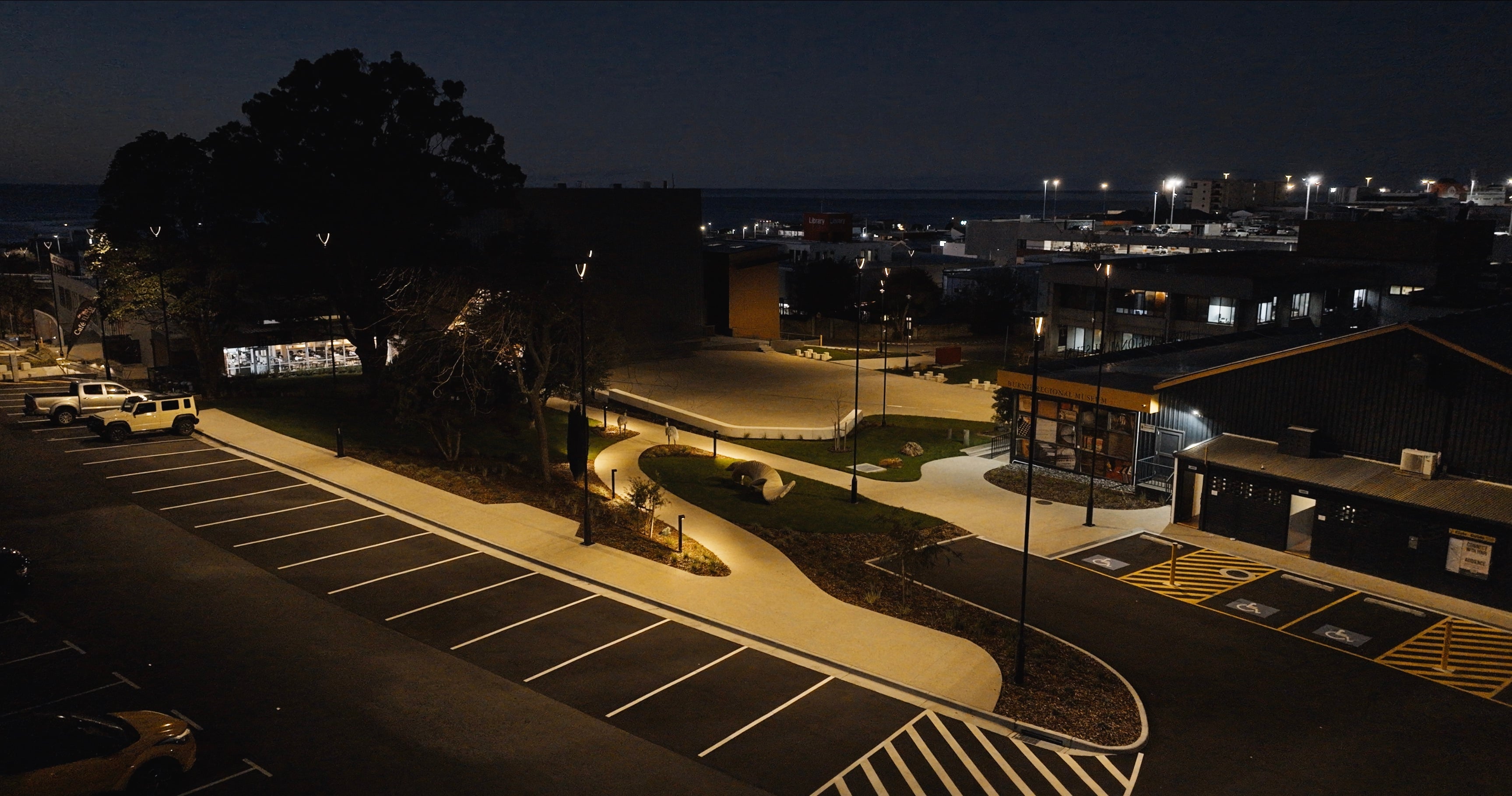
Two streetlights with identical wattages can throw completely light patterns on the road, depending on their light distribution design. This is where the distribution type comes in – the shape of the light pool a fitting casts and it’s often just as important as wattage and pole height when planning a lighting layout.
Common distribution types:
Type II (Side throw) – a long, narrow oval running parallel to the road. Used for wide walkways, on ramps and entrance roadways as well as long narrow lighting.
Type III (Side + Forward throw) – a wider oval that spreads light forward as well as sideways. Meant for roadway lighting, general parking areas and other areas where a larger area of lighting is required.
Type IV (Forward throw) – projects light mainly in one direction. Meant for mounting on the sides of buildings and walls
Type V (Symmetric/circular throw) – spreads light in all directions rather than favouring one side or one direction. Intended for the luminaire mounting at or near the centre of roadways, centre islands of parkways and intersections.
No related products found.