
Wind Load Rating Explained for Australian Conditions (AS/NZS 1170.2)
Tagged:
- Knowledge
- Technical Guides
A light pole that suits a Melbourne suburb may not be safe on the Pilbara coast. Every pole we supply has to be rated for the wind conditions at its site. Getting it right at the quote stage avoids delays, redesigns and poles that are bigger and cost more than you need.
In Australia, pole wind ratings follow AS/NZS 1170.2:2021, Structural Design Actions – Wind Actions. The standard combines four main factors to work out the wind pressure (in kPa) a pole must withstand: where the site is, what surrounds it, how tall the pole is, and what’s attached to it.
Australian Wind Regions:
Australia is divided into wind regions based on how strong the local wind gets. It’s the starting point for every design.
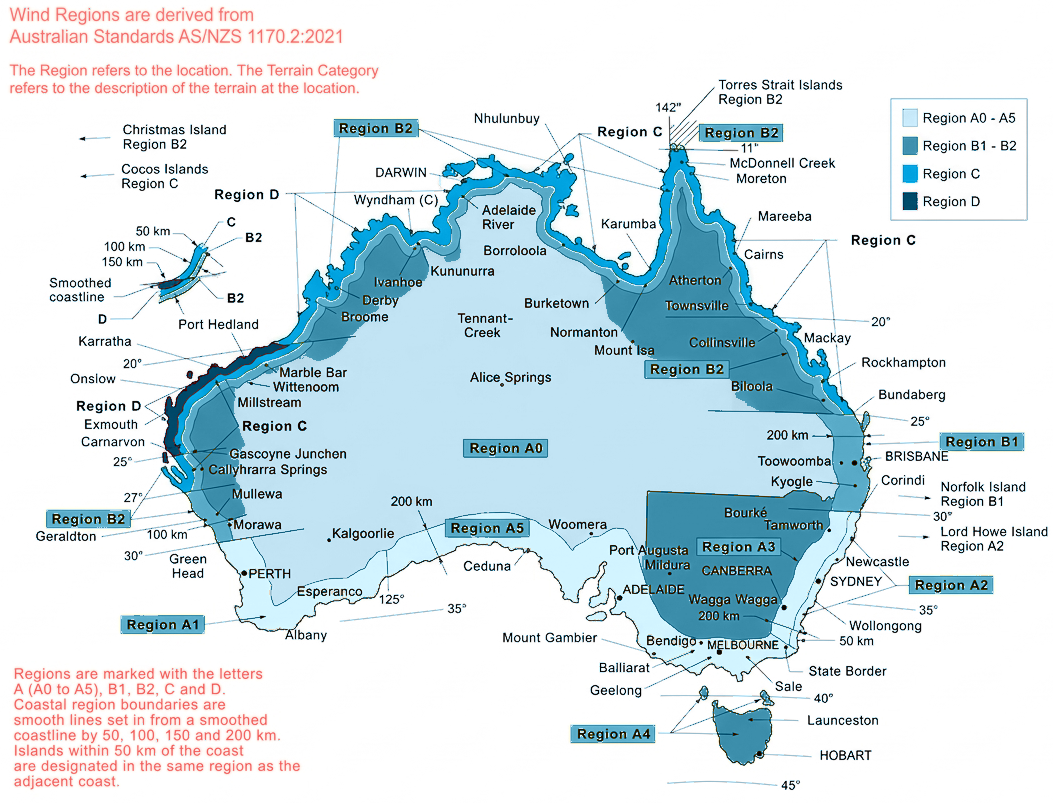
Region A (Normal): Regional wind speeds up to 155 km/h (standard non-cyclonic inland/suburban areas such as southern/inland Australia, including Tasmania.)
Region B (Intermediate): Wind speeds up to 188 km/h (intermediate or near-coastal regions)
Region C (Cyclonic): Wind speeds up to 220 km/h ( tropical cyclonic areas like coastal Queensland, WA, NT coastal)
Region D (Severe Cyclonic): Wind speeds up to 260 km/h (extreme costal cyclone zones, such as parts of northwest Western Australia).
These speeds are typical maximums. The design speed for your project also depends on the pole’s importance level, and in Regions C and D, how far the site is from the coast.
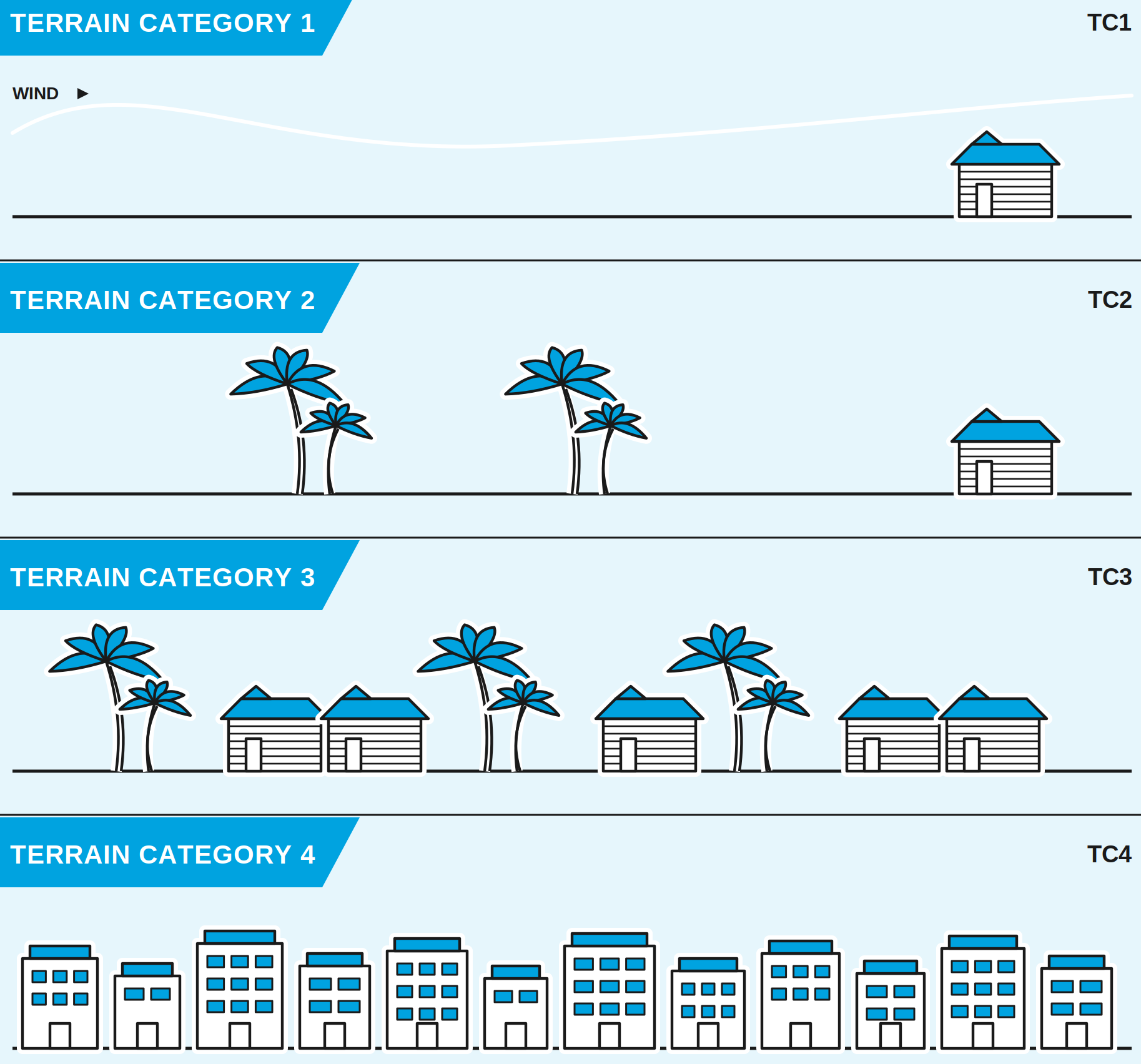
Terrain categories:
Defines how the ground roughness and surrounding obstacles slow down or accelerates wind forces acting on structures.
Terrain Categories | Descriptions | Typical Examples |
TC1 – Very exposed/ smooth terrain | Very exposed terrain with minimal obstructions | Open sea, lakes & flat plains |
TC2 – Open Terrain | Open terrain, with well-scattered obstructions 2m to 10m high | Farmland, cleared subdivisions with isolated tree and uncut green |
TC3 – Suburban / built-up | Numerous closely spaced obstructions the size of houses | Suburban housing blocks, towns and light industrial estates, commonly used standard for housing wind rating. |
TC4 – Dense urban/ city terrain | High built-up areas with large, tall and dense buildings | Central business districts or heavy industrial complexes |
Pole height:
Wind speed increases with height above ground. As pole height increases, wind forces can increase significantly, resulting in larger bending moments, greater deflection, and larger foundations.
Attached Equipment (EPA):
Wind load is not determined by pole height alone. Attached equipment such as luminaires, CCTV cameras, solar panels, banners and communication equipment all contribute additional wattage. This is commonly expressed as Effective Projected Area (EPA), measured in square metres (m²).
Key takeaways:
- Wind Regions determines the base wind speed
- Terrain Category adjusts how surrounding building and vegetation affect wind loads
- Pole height increases wind exposure
- Attached equipment contributes additional wind loading through EPA
- Always ensure poles are certified for the site-specific wind conditions in accordance with AS/NZS 1170.
No related products found.